Appearance
Access Control List
An ACL (Access Control List) controls which users, roles and user types can read, edit or delete reports, data sources, models and folders.
For the complete relationship between User Types, Business Roles, ACLs, RLS, and OLS, see Permission Evaluation Overview. An ACL grant does not replace data policies, and an unchecked permission is not an explicit deny that cancels another matching grant.
1. What is ACL?
ACL is a permission control mechanism used to define access rights for resources. In Datafor, resources include data sources, models, report files, and folders. ACL allows administrators to set permissions for these resources. The available permission levels are:
- Read: The user can view the resource content.
- Edit: The user can modify the resource. Edit does not allow deleting it.
- Delete: The user can delete the resource (move it to the Trash), in addition to Read and Edit.
- Full control: Grants the user complete control over the resource, including the ability to manage permissions for other users or roles.
Deleting a report, folder, or analysis model requires Delete or Full control, granted to the user, one of their roles, their user type, or Authenticated, directly or inherited from the folder. Edit on a folder does not let a user delete the reports in it. When several reports or folders are deleted at once and one of them lacks Delete, none of them is deleted. See Deleting requires Delete or Full control.
2. User and Role Authorization
You can grant access to individual users, to business roles (every member receives the grant), and to user types.
2.1 Assigning Permissions
Permissions must be explicitly granted to users, roles, or user types for each resource (such as reports, data sources, or models). Follow these steps to assign permissions:
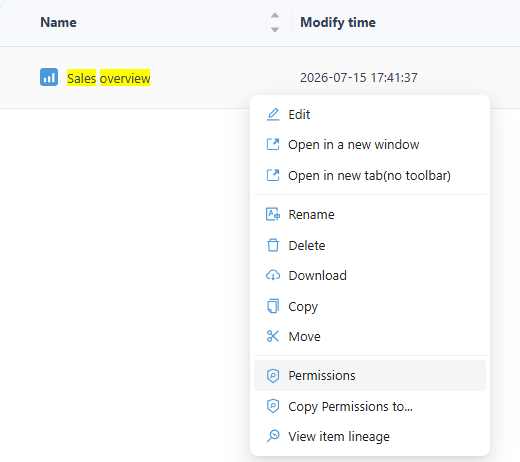
In Public (or another folder you manage), open the row menu of the report or folder and click Permissions.
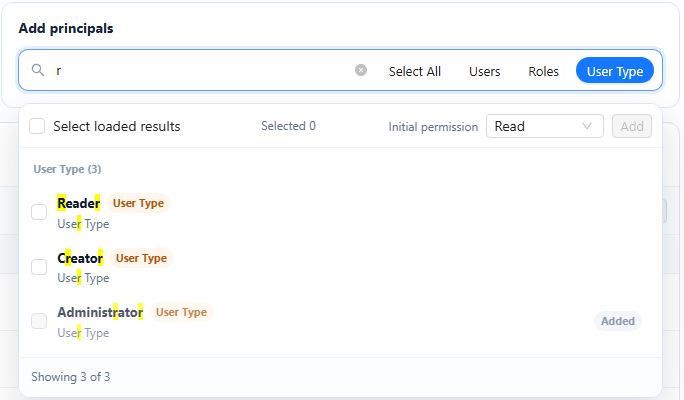
In Add principals, search for users, roles or user types; narrow the results with Users, Roles or User Type. Tick the principals, choose the Initial permission and click Add. Principals that already have entries show Added.
In Authorized principals, set Read, Edit, Delete and Full control for each row. To change several rows at once, select them, choose a level in Batch grant and click Apply. Delete in a row, or Remove selected, removes the grant. Locked rows, such as the Administrator user type, cannot be changed.
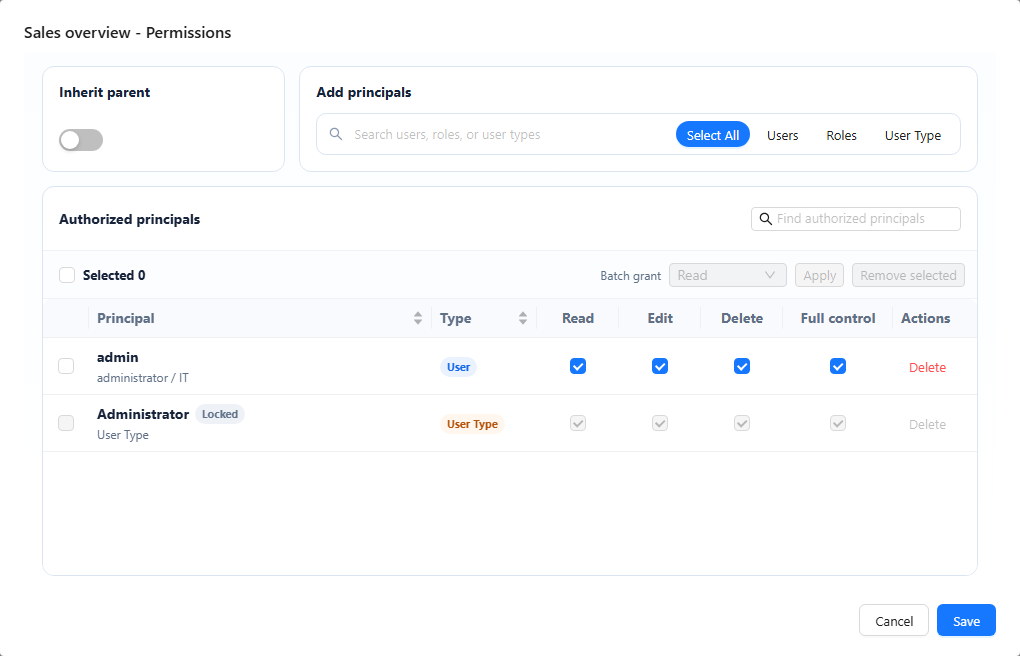
Click Save.
If the notice Permissions saved appears, some of the users or roles you granted lack Read on what the content depends on: the data source of a granted model, or the models and data sources used by a granted report or folder. Grant that access in the Models and Datasource lists, then click Got it. The notice does not change any permissions. The same check runs after Model permissions and File permissions on the Users and Roles pages. See Check what grantees still need.
2.2 User-Type-Based Authorization
Datafor provides three user types (see User Creation and User Types):
- Reader: Can view granted content but cannot create or modify it.
- Creator: Can create reports, models and other content, and edit content they own or are granted.
- Administrator: Has full control over all resources, including permission management.
A grant to a user type applies to every user of that type. For example, granting Read on a folder to Reader lets all Reader users open it. For the Reader user type and for Reader users, only Read can be granted.
3. Folder and Report Authorization
Folder and report authorization in Datafor has certain restrictions:
- Private Folders: Reports and folders within private directories cannot be shared with other users or roles.
- Public Folders: Only reports and subfolders in public folders can be authorized for access by other users or roles.
4. Permission Inheritance
Reports and subfolders with Inherit parent enabled use their parent's effective ACL. If the parent also inherits, follow the chain to the nearest non-inheriting ACL. Disabling inheritance selects the resource's own entries; it does not add a local deny on top of the parent grants. Parent changes affect descendants that continue to inherit, not descendants with their own ACLs.
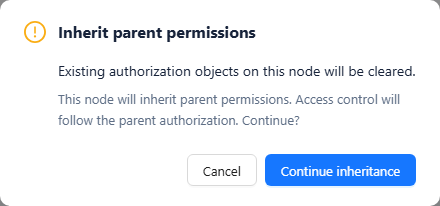
Turning Inherit parent on clears the item's own entries. Datafor asks for confirmation first, in the Inherit parent permissions dialog: "Existing authorization objects on this node will be cleared." Click Continue inheritance, then Save; the item is saved with no entries of its own. To give it its own permissions again later, turn Inherit parent off and add the entries again.
For grant combination, folder-operation checks, and owner/administrator exceptions, see File and folder ACLs.
5. Viewing Permissions
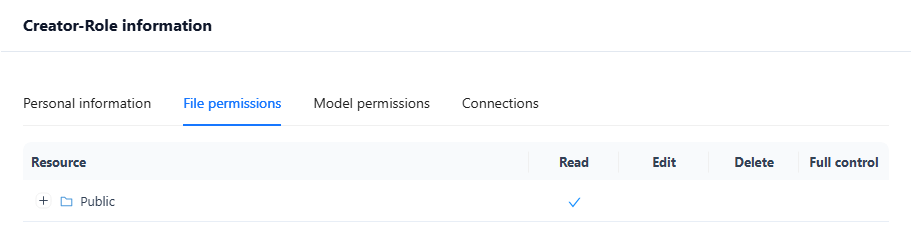
On the Users page (Users, Roles or User Type tab), open a row's menu and click Details to see what that user, role or user type can access. Details has the tabs Personal information, File permissions, Model permissions and Connections.
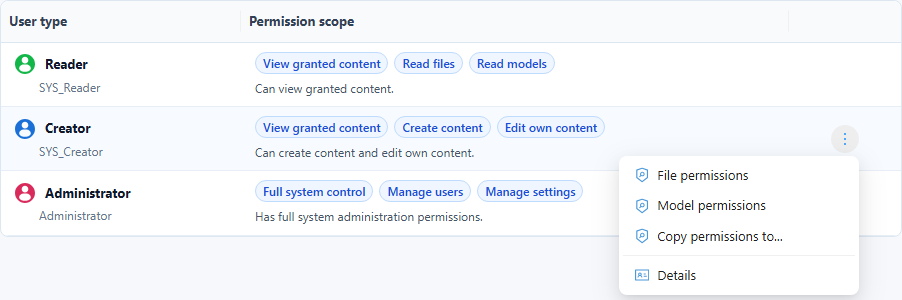
Each permissions tab lists the granted items with their rights (Read, Edit, Delete, Full control).