
Appearance
Connect AI Clients (MCP)
Datafor offers an MCP (Model Context Protocol) server, so you can ask about your data from the AI assistant you already use: Claude Desktop, Claude Code, Codex, Cursor, VS Code, Cherry Studio, or any agent that supports MCP. Each question runs as a governed query in Datafor under your own account. The AI client sees only the analysis models and data you can see in Datafor.
By default Datafor returns the result rows, the query behind them and any disclosures, and the AI client writes the answer from those rows. Datafor instructs the client never to change a value and to label anything it calculates itself as its own work.
This page applies to Datafor 10.00 and later. 10.00 is the first version in which users see Connect AI.
1. What the AI client can do
Once connected, the client has four Datafor tools:
| Tool | What it does |
|---|---|
list_models | Lists the analysis models you may query, with search and paging. |
explore_model | Describes one model as you may see it: its metrics, dimensions and time fields. |
generate_sample_questions | Suggests one to five questions (three by default) that the model can answer, built from its own metrics and dimensions. |
ask_datafor | Asks one question in natural language and returns the result rows, the query behind them, the disclosures and an analysis_context_id for follow-ups. It is also used to answer a clarification. |
- Same permissions as in Datafor. A model you cannot open in Datafor is not listed, and row-level policies apply as usual.
- Read only. The tools run queries and change nothing in Datafor. Building indexes, editing models and other administration are not available.
- No raw access. The client gets no SQL, MDX, back-end payloads or other users' data.
- Answers are written by the client. The wording therefore differs from an answer on the AI Agent page. If you want Datafor's own written analysis, say so; the client then asks with
detail: "insight"(see section 5).
2. Open Connect AI
- Open AI Agent in the left navigation, below Home.
- Click Connect AI in the page header. In the embedded AI side panel, use the icon button with the tooltip "Connect AI".
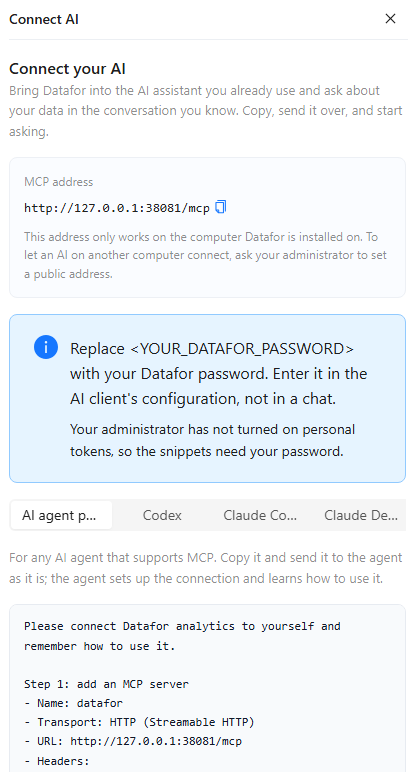
The Connect your AI panel contains:
| Part | Content |
|---|---|
| MCP address | The address your AI client connects to, with a copy button. "This address only works on the computer Datafor is installed on…" means the server listens on that computer only; to connect from another computer, your administrator must publish an address (section 8.2). "This address is built from the host name you are using to reach Datafor…" means the administrator opened the server to the network without naming a public address; if it does not connect, ask for the public MCP address. |
| Sign-in notice | Either Generate token, or, when personal tokens are off, the password notice (see below). |
| Client tabs | AI agent prompt, Codex, Claude Code, Claude Desktop, JSON config, each with a short instruction and Copy. |
| Once it's connected, try asking | Sample first questions. |
| Tools the AI can use | The tools listed in section 1. |
If the panel shows "The MCP connection is not turned on. Contact your administrator.", the MCP channel is switched off on the server (section 8.3).
Personal token or password
Every snippet in the panel already contains the address and the sign-in headers. Which sign-in it uses depends on the server:
| Sign-in | When | What to do |
|---|---|---|
| Personal token | Your administrator has turned on personal tokens (section 8.1). The panel offers Generate token. | Click Generate token. The panel shows "Token generated, valid for n days" and puts the token into every snippet (Authorization: Bearer <token>). Click Generate again when it expires or may have leaked, then update your client. |
| Password | Personal tokens are off. The panel says "Your administrator has not turned on personal tokens, so the snippets need your password." | The snippets carry X-Datafor-Username (your user name), X-Datafor-Password with the placeholder <YOUR_DATAFOR_PASSWORD>, and where needed X-Datafor-TenantId. Replace the placeholder with your Datafor password in the AI client's configuration file, never in a chat. |
A token stands for you and your permissions. It contains only your user name and an expiry date, not your roles: signing in with it gives you the permissions you have in Datafor at that moment. A session that was itself opened with a token, a share link or an anonymous session cannot generate a token.
3. Set up your AI client
Pick the tab for your client and click Copy. The examples below show the token form; the password form has the two X-Datafor-… headers instead.
Claude Desktop
Claude Desktop reaches Datafor through the Datafor extension, datafor.mcpb. Node.js 18 or later must be installed, because the extension runs npx. On its first start, npx downloads the mcp-remote package.
Get
datafor.mcpbfrom your administrator.In Claude Desktop, open Settings › Extensions › Advanced settings › Install extension and choose the file. You can also drag the file into the Claude window.
Fill in the extension settings:
Field Value URL The MCP address from the panel. Default http://127.0.0.1:38081/mcp.Personal token Your token. With a token, leave the other fields empty. Username / Password Only when personal tokens are off. Tenant ID Usually empty. npx path Usually empty. Fill in the full path only when Claude cannot find npx.Open a new conversation (open conversations do not load a new extension) and ask: "Use Datafor to list the analysis models I can access."
If Claude Desktop starts before Datafor is up, the extension keeps retrying for about two and a half minutes on its first connection. To upgrade the extension, uninstall the old version first, then install the new one.
Claude Code
Run the copied command in a terminal, then reopen Claude Code:
claude mcp add --transport http datafor "http://127.0.0.1:38081/mcp" --header "Authorization: Bearer <token>"claude mcp list should show the server as connected. Claude Code and Claude Desktop keep separate configurations: a server added with claude mcp add does not appear in Claude Desktop conversations, and the other way round.
Codex (desktop app, CLI and IDE extension)
Open your Codex user configuration:
~/.codex/config.tomlon macOS and Linux,%USERPROFILE%\.codex\config.tomlon Windows, orconfig.tomlin$CODEX_HOMEwhen that is set.Merge the copied section into the file and keep the rest. If a
dataforserver is already there, update its section instead of adding a second one.[mcp_servers."datafor"] url = "http://127.0.0.1:38081/mcp" tool_timeout_sec = 600 [mcp_servers."datafor".http_headers] "Authorization" = "Bearer <token>"Save, restart Codex, open a new conversation and ask: "Use Datafor to list the analysis models I can access."
The desktop app, the CLI and the IDE extension on one computer share this configuration. Codex connects to the HTTP server directly: no extension, Node.js or codex mcp login is needed. tool_timeout_sec = 600 leaves time for slower analyses. In the CLI, codex mcp list shows the configuration and /mcp the connection status. Codex cloud tasks do not read the configuration on your computer.
Cursor, VS Code, Cherry Studio and other clients with a JSON configuration
Paste the JSON config tab into the client's MCP configuration file (see the client's own documentation for where it is), then restart the client:
{
  "mcpServers": {
    "datafor": {
      "type": "http",
      "url": "http://127.0.0.1:38081/mcp",
      "headers": { "Authorization": "Bearer <token>" }
    }
  }
}
If the client cuts tool calls off after a short time, raise its tool timeout. A question usually takes under a minute; with Datafor's written analysis it can take about three minutes.
Any agent that supports MCP
Copy the AI agent prompt tab and send it to the agent as it is. The prompt asks the agent to add an MCP server named datafor (Streamable HTTP) with the address and headers, to verify the connection with list_models, and to remember how to use Datafor: settle the model first, explore an unknown model, ask one step at a time in your words, pass analysis_context_id for follow-ups, answer clarification_needed and needs_split, write the answer from the rows and report every disclosure.
With the password form, the prompt asks the agent to tell you which file holds the configuration, so that you replace <YOUR_DATAFOR_PASSWORD> there yourself. With the token form, it tells the agent to write the token only into its configuration and never repeat it.
4. Check the connection
Ask these three questions in order. When all three return results, the connection works end to end:
- "Use Datafor to list the analysis models I can access."
- "Use Datafor to show the metrics and dimensions of the model "model name", then suggest a few questions I could ask."
- "Use Datafor to analyze: a business question you care about."
5. Asking from an AI client
- One step at a time. Ask a question that one query can answer: a metric, the dimensions and the time range. The client should split a complex question into such steps itself.
- The model is optional. Name it when you know it. Otherwise Datafor picks one from your models and the Metrics Library bindings, or asks you to choose; the client should tell you which model answered (
data.resolved_model). - Follow-ups keep the context. "Now by month" or "only East" continues the earlier analysis; the client passes back the
analysis_context_idof the step you build on, which can be any earlier step. - Answer clarifications. When Datafor needs a choice, the client shows the options; pick one and the analysis continues.
- Disclosures are relayed. Assumptions, member mappings, omitted parts and truncation come back as disclosures, and the client must tell you each one.
- Forecasts and causes go to Datafor first. The client relays what Datafor answers and computes beyond it only if you ask, labelled as its own work.
- Data or insight. The default (
detail: "data") returns rows, the query and disclosures, and Datafor writes no analysis or follow-ups. Withdetail: "insight", Datafor also writes its own analysis, may run several queries for a complex question and can take about three minutes. Ask for it explicitly. - Row limit. A result returns up to 200 rows by default. Ask for more and the client passes
max_rows, up to 1000. - Long analyses come back later. If the answer is not ready within the wait time (200 seconds by default), the call returns
pendingwith arun_id, and the client collects the answer by calling again with thatrun_idalone. The analysis keeps running in the meantime. - Metrics Library notes such as "draft" or "definition drift" are not returned in the default data mode.
What a response can say
| Status | Meaning | What the client should do |
|---|---|---|
ok | The query ran and returned its rows. | Write the answer from the rows and relay the disclosures. |
partial | Part of the question could not be answered, for example a comparison that could not be computed. | Answer with what is there and say what is missing. |
clarification_needed | Datafor needs a choice from you, such as the model or a member. | Show the message and the options, then reply with your choice. |
needs_split | The question needs several dependent queries. This is not a failure. | Split it and ask the parts one at a time. |
unsupported | The question is outside what the model can answer. | Relay Datafor's message; do not answer from general knowledge. |
pending | The answer was not ready within the wait time (MCP_ASK_TIMEOUT_SECONDS, 200 seconds by default). The analysis is still running. | Call ask_datafor again with only the run_id from the response, not the question. |
error | The call failed. | Retry once only if the response says it is retryable; otherwise report the failure. |
6. Troubleshooting
| Symptom | Cause and fix |
|---|---|
| Claude Desktop shows no Datafor tools | Open a new conversation; check that the extension is enabled. If Claude started before Datafor and the retries ran out, turn the extension off and on in Settings › Extensions, or restart Claude. |
Claude Desktop cannot find npx | Install Node.js 18 or later, or enter the full path in the extension's npx path. |
| Codex shows no Datafor tools | Check that the section from the Codex tab is in the user config.toml that Codex actually uses, save, restart Codex, and check that the MCP address is reachable. |
| Codex reports a duplicate section | A server name may appear only once. Update the existing datafor section and keep the other servers. |
Missing Datafor MCP authentication. | No credential reached the server: the token or headers are missing or malformed. Generate a token again and update the client configuration. |
| 401 or a sign-in failure on a tool call | The token has expired or is wrong, or, with headers, the password is wrong or the account is disabled. |
421 Invalid Host header | The server is reached under a host name that is not in MCP_ALLOWED_HOSTS (section 8.2). |
| Cannot connect, or the call times out | The MCP server is not running, or the address only works on the Datafor computer. Ask your administrator. |
| "The MCP connection is not turned on." | The administrator has switched the channel off (section 8.3). |
| A question about a specific store or region loses its filter or cannot be answered | The model's knowledge index is not built or out of date. See Preparing Data for AI. |
| The answer says Datafor cannot answer this | A capability limit, not a fault. Rephrase, or split the question. |
The Claude Desktop extension writes its log to %LOCALAPPDATA%\Claude\logs\mcp-server-Datafor.log (in some versions under %APPDATA%\Claude\logs\). Check its last lines first when the connection fails. The server log is ai-agent/logs/mcp-server.log (and mcp-server-err.log) on the Datafor server.
7. Security
- A personal token or a password in a client configuration stands for you and all your permissions. Keep it only in your own AI client's configuration; do not paste it into a chat, commit it to a repository or forward it. On a shared computer, remove the configuration when you are done.
- A new token does not invalidate the old one. If a token may have leaked, generate a new one and tell your administrator, who can revoke all tokens at once (section 8.1).
8. For administrators
8.1 Turn on personal tokens
Without personal tokens, users connect with their Datafor password. To let them generate tokens, create a JWT configuration with self-service enabled. The setting self_service has no field in the console, so set it with an API call while signed in as an administrator:
POST /datafor/plugin/datafor-modeler/api/token/update
{"name":"ai-connect","token_name":"token","secret":"<at least 32 random characters>","expire":7776000,
 "algorithm":"HS256","enable":"1","inituser":"0","initroles":["SYS_Reader"],
"fieldmap":{"username":"username","name":"name","email":"email"},"self_service":"1"}| Key | Requirement |
|---|---|
self_service | "1": signed-in users may issue a token for themselves. |
enable | "1". |
algorithm | An HMAC algorithm such as HS256, with a secret. |
expire | Validity in seconds; 7776000 is 90 days. The panel shows it in days. |
inituser | Not required for personal tokens. |
Editing the configuration later on Settings › Access & Integration › Embed tokens (JWT) keeps self_service. See JSON Web Token (JWT) for the other fields.
Changing the secret of the configuration invalidates every token issued from it at once. It is the only way to revoke tokens.
8.2 Let other computers connect
By default the MCP server listens on 127.0.0.1:38081, so only AI clients on the Datafor computer can connect. Set these keys in .env in the AI Agent folder (bi-server/ai-agent/.env):
| Key | Default | Purpose |
|---|---|---|
MCP_HTTP_HOST | 127.0.0.1 | Listen address. Set 0.0.0.0 to listen on the network, or keep 127.0.0.1 behind a reverse proxy on the same computer. |
MCP_HTTP_PORT | 38081 | Listen port. |
MCP_ALLOWED_HOSTS | empty | Comma-separated Host header values accepted besides the local addresses, for example bi.example.com,bi.example.com:*. Any other host name gets 421 Invalid Host header. If MCP_HTTP_HOST is a network address and this key is empty, the server does not check the Host header at all and logs a warning; list your names to keep the check. |
MCP_ALLOWED_ORIGINS | empty | Comma-separated Origin values accepted besides the local ones, for browser-based clients. |
MCP_PUBLIC_URL | empty | The address shown in Connect AI, for example https://bi.example.com/mcp. Read by the AI Agent service, not by the MCP server. When it is empty, the panel shows http://127.0.0.1:<port>/mcp for a local listen address, or builds the address from the host name the user opened Datafor with. |
Then restart the AI Agent from its folder with app-console.bat restart (Windows) or ./app-console.sh restart (Linux). Without a target this restarts the AI Agent and the MCP server; MCP_PUBLIC_URL is read by the AI Agent service and the listen settings by the MCP server.
Behind a reverse proxy, forward /mcp to the MCP server, use HTTPS, list the public host name in MCP_ALLOWED_HOSTS and set MCP_PUBLIC_URL to the public address. Allow responses of up to five minutes. The server keeps no session between calls, so the proxy needs no sticky sessions, and connected clients keep working after Datafor or the AI Agent restarts or is upgraded.
8.3 Switch the channel or password sign-in off
| Key | Default | Effect |
|---|---|---|
AGENT_VNEXT_MCP_ENABLED | true | false switches the MCP channel off. The panel then says "The MCP connection is not turned on. Contact your administrator." |
MCP_PASSWORD_SESSION_AUTH_ENABLED | true | false rejects the X-Datafor-Username / X-Datafor-Password headers, so only personal tokens work. Turn on personal tokens first. |
Restart with app-console.bat restart or ./app-console.sh restart after a change.
8.4 Wait time and time zone
| Key | Default | Effect |
|---|---|---|
MCP_ASK_TIMEOUT_SECONDS | 200 | Seconds one ask_datafor call waits for the answer before it returns pending with the run_id. Keep it below the AI client's own tool-call limit (Codex: 60 seconds unless tool_timeout_sec is raised). |
MCP_DEFAULT_TIMEZONE | empty | IANA time zone, for example Europe/Berlin, in which relative dates such as "last month" resolve when the AI client sends none. Empty: the current UTC offset of the server, or UTC if that offset is not a whole number of hours. |
Set them in ai-agent/.env and restart with app-console.bat restart or ./app-console.sh restart.
8.5 Prepare the models and the server
- Build the knowledge index of each model users will ask about (older versions called it the vector index). Without it, questions that name specific members can lose their filter. See Preparing Data for AI.
- Assign the Question Suggestions stage on the LLM page. Without it,
generate_sample_questionscan only use the LLM configured in Datafor whose ID is set asAGENT_DEFAULT_LLM_IDinai-agent/.env, and for users who are not administrators only with the shared secret. With neither, it returns no questions. - Distribute
datafor.mcpbto users of Claude Desktop.
8.6 After upgrading to 10.00
- Claude Desktop users reinstall the extension: uninstall the old version first, then install the new one. The new version passes the token header correctly on Windows and waits for Datafor to start.
- Nothing to do for Claude Code, Codex or JSON clients. Clients that were connected before the upgrade keep working.